Visit
History of Middlefield
Middlefield was formed from Cherry Valley on 3 March 1797, and is the largest town in Otsego County.
The town
Middlefield
The Land
Nestled in the heart of New York State's Leatherstocking Region, Middlefield runs along the eastern side of the beautiful Otsego Lake, the famed "Glimmerglass" from James Fenimore Cooper's Leatherstocking Tales. The largest town in the county, it features gently rolling hills and farmland divided by the meandering Cherry Valley Creek and Red Creek as they wind their way to the Susquehanna River.
1740 · First Settlers
In 1740, John Lindsay and a group of about 30 other Scotch-Irish pioneers established the small settlement of Cherry Valley, deep within the frontier wilderness of what is now Otsego County. Completely isolated from any larger colonies, the earliest settlers persevered facing extreme weather conditions, starvation, and eventual Indian hostilities. A mere twenty years after the Cherry Valley settlement was established, the first settlers entered the area that later came to be known as Middlefield. They settled in an area called Newtown-Martin which later became the hamlet of Middlefield Center along the road leading west out of Cherry Valley. Among these first settlers were the McCollums - Alexander, Benjamin, Daniel and Reuben - along with Samuel and Andrew Wilson, William Cook, Andrew Cameron, and Andrew Cochran.
In the mid-eighteenth century Middlefield was divided into several large tracts of land, called patents, which were named after the individuals who secured them through royal land grants. The Godfrey Miller Patent covered much of the northwest portion of the town, while the John Bowers Patent covered the southwest. The eastern edge of town was defined by the Volkert Outhout Patent, also called the Long Patent. This narrow strip of land, which was transferred to George Clarke in 1772, ran the entire length of the town and straddled the Cherry Valley Creek.
1779 · The Revolution
During the Revolutionary War the area was under constant threat of Indian attack since the Indians were aligned with the British. In 1779 the settlement at Cherry Valley was nearly wiped out by Indians in what is known as the Cherry Valley Massacre. Although the region was virtually evacuated at this time, after the conclusion of hostilities, eager settlers flooded back to the area. Among these post-Revolutionary War settlers were some notable men who shaped the early history of Middlefield.
1780s · Pioneers and Mills
In the 1780s Benjamin Gilbert purchased a farm in the Middlefield Center area. When he first arrived, he taught school in Cherry Valley, but later used his skills as a surveyor to make his fortune. He became acquainted with the notable men of the area such as William Cooper, the founder of Cooperstown, and George Clarke, the great English land owner, and grandson of the man who acquired the Long Patent. Clarke built his palatial residence, Hyde Hall, on Mount Wellington, overlooking Otsego Lake. Gilbert went on to become the second sheriff of Otsego County and a representative to the New York State Assembly. He also served as Supervisor of the Town of Middlefield from 1803 to 1809 and from 1812 to 1816.
Col. Moses Rich, who settled in the southern portion of town, known as the hamlet of Westville, is credited with setting up the first saw mill in 1795. He later added to his holdings by setting up a grist mill and in 1798 opened a tavern. In the early part of the nineteenth century he helped his son, also named Moses, establish a mill in the hamlet of Clarksville, later known as the hamlet of Middlefield.
Others among these early pioneers were: Reuben Beals, Bernard and William Temple, William Compton, Whitney Jurill, Stephen and Thomas Pratt, William Cook, Daniel Moore, and John Parshall. Some of these early settlers deserve special note. Dr. Obadiah Dunham settled in the area below Bowerstown in about 1755. He was born in Pownal, Vermont in about 1731. Dr. Sumner Ely, who settled in Clarksville in about 1810, was the brother-in-law of Jedediah Peck, Judge William Cooper's great nemesis, and married Hannah Gilbert, the daughter of Benjamin Gilbert. Finally, there is Joshua Pinney, who settled in Clarksville in about 1803 and started an early tavern. Pinney was also instrumental in establishing the first school in the hamlet in 1807, as well as a store, a tannery, a distillery, and the Baptist Church.
1802 · Churches
The religious community in Middlefield banded together at quite an early date. In 1802 the Reverend William Colbert preached probably the first Methodist sermon in Middlefield Center at the home of Daniel McCollum. The congregation later built a church in 1832 in the hamlet of Middlefield at a cost of $2,000 on land donated by George Clarke of Springfield. Around the same time, the Baptist community was also taking root. Elder Benjamin Sawin first preached in the hamlet of Clarksville around 1806, and by 1810, the First Baptist Society was established in Middlefield. The congregation regularly met in the schoolhouse Pinney had helped establish on the hill overlooking the hamlet. In 1826 they built their present church on lands that again were donated by George Clarke. The design of the church was based on the architectural style of Asher Benjamin, the noted Boston architect. It was also in about 1806 that the Presbyterians built their first church in Middlefield Center. After formally organizing in 1821, their growing membership of some eighty-nine people required a new church by 1843. Later in the century they built an additional small chapel in the hamlet of Bowerstown.
1815 · Mills, Farms and Hops
The early nineteenth century also saw significant business activity in the town. In 1815 the Phoenix cotton mill was established and its original building was replaced in 1835 by a stone structure, which later became a woolen mill in 1866. Middlefield Center also became a hub for industry, hosting a shoelace factory that ranked among the largest in New York State. Also, in 1828, the Otsego County Farm, or Poor House, was set up along the Susquehanna River to support those who had fallen on hard times. As both business and population grew, the United States Postal Service opened several offices throughout the town. Post Offices were established in Clarksville (renamed Middlefield so as not to conflict with an earlier Clarksville in Albany County), Middlefield Center, Westville and Lentsville.
Though business activity grew, agriculture remained the backbone of the economy. Early settlers grew and sold a variety of grains, particularly wheat, but as the 1820s dawned, farming steadily shifted toward dairying and related activities such as cheese making. This diversity in agriculture almost completely vanished as hop growing mania swept Otsego County. Farmers quickly took to this cash crop, hoping for fantastic profits in a risky business: fortunes were made and lost. As soil exhaustion took its toll on the land, farmers returned to dairying as the century ran its course.
1875 · The Civil War and the Schoolhouse
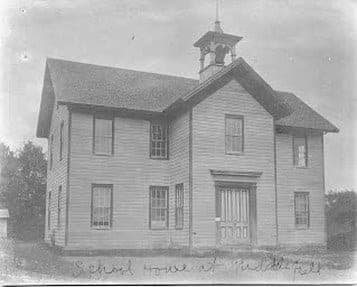
With the coming of the Civil War, many men from Middlefield were mustered into the 121st Infantry Division of the Union Army, although others enlisted in the 42nd, 43rd, and 76th Regiment. These men saw action at Antietam, Bull Run, Fredericksburg, Wilderness and Salem Chapel. With the end of the Civil War, the population in the town stabilized after its war era decline. One of the results was the need for a larger schoolhouse in the hamlet of Middlefield. This schoolhouse was built on a rise of land near the mill in the hamlet. It opened in 1875 and ran until 1954 when it was centralized with the Cherry Valley district. Forty years earlier, four small school districts had consolidated at Middlefield District No. 1 and several had consolidated at Westville District No. 2. A new building was erected in Westville to accommodate these students.
1934 · Fire
The ravages of fire took their toll in the twentieth century with three major fires ushering in an era of decline in Middlefield. In 1934 the American Hotel in the hamlet of Middlefield suffered the loss of its main section and in 1942 the store of Charles Hearn, also in the hamlet, was gutted by a fire that started in the Roberts house next door. Mrs. Roberts barely made it out alive after re-entering the house to retrieve her purse. Finally, when the Morton house lost a wing to fire in 1955, a group of men banded together to form the Middlefield Volunteer Fire Department. From their first headquarters in a converted garage, they have come to occupy a modern three-bay firehouse.
A Resurgence
Although many people and businesses left Middlefield by the mid-twentieth century, the town has witnessed a resurgence in activity as the century came to a close. The Old District No. 1 Schoolhouse became headquarters for the Middlefield Historical Association and host to a variety of activities in the summer, the two churches in the hamlet of Middlefield formed a cooperative parish and began alternating services at both buildings, and in the 1980s, the hamlet of Middlefield was listed on the National Register of Historic Places. Throughout its history the town of Middlefield has remained a picturesque and quiet rural town. Referred to as the "Land of Steady Habits," its residents have been industrious and content in the place they call home.
From the archive
Photographs of the town
“School house at Middlefield” 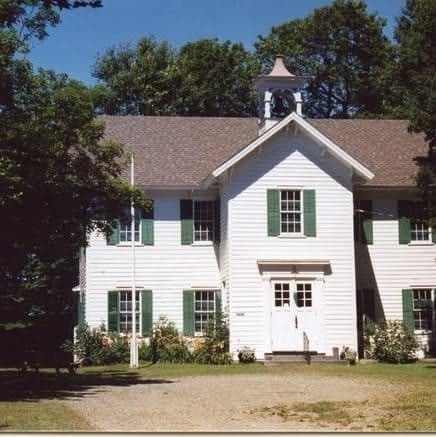
District No. 1 Schoolhouse 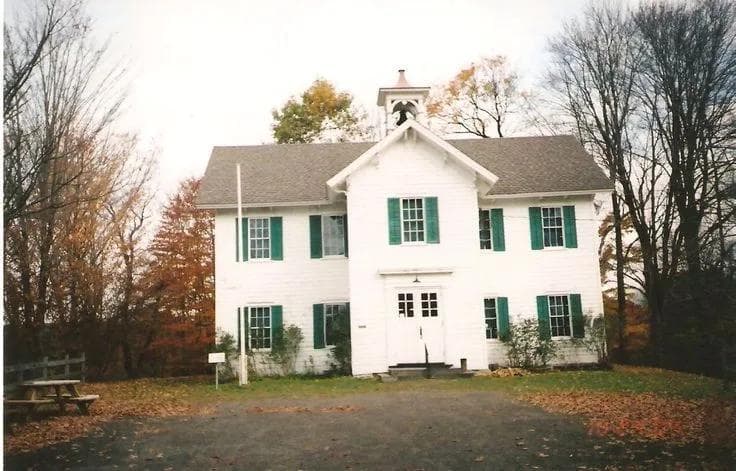
Built 1875, east of Cherry Valley Creek
A different organisation
The Town of Middlefield
The Town of Middlefield is the municipal government, separate from this historical association. For town business — meetings, assessments, permits and local services — visit the town’s own website.
Visit the Town of Middlefield’s website (opens in a new tab)